
Dublin, April 28, 2026 (GLOBE NEWSWIRE) — The “CV Depot Charging – Global Strategic Business Report” report has been added to ResearchAndMarkets.com’s offering.
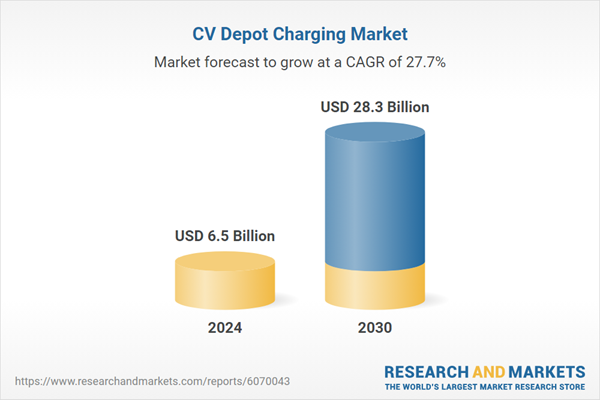
The global market for CV Depot Charging was valued at US$6.5 Billion in 2024 and is projected to reach US$28.3 Billion by 2030, growing at a CAGR of 27.7% from 2024 to 2030. This comprehensive report provides an in-depth analysis of market trends, drivers, and forecasts, helping you make informed business decisions.
What Is Driving the Growth of the CV Depot Charging Market?
The growth in the CV depot charging market is driven by the increasing electrification of commercial vehicle fleets, advancements in high-power charging technology, and supportive government policies. The rising demand for sustainable logistics and zero-emission transportation has accelerated investments in depot charging infrastructure, particularly among last-mile delivery and transit operators. The integration of AI-driven energy management solutions and dynamic load balancing is further optimizing charging efficiency, enabling fleets to reduce operational costs while maximizing vehicle uptime.
End-use expansion is another key factor, with logistics companies, municipal transit agencies, and corporate fleets increasingly adopting depot charging solutions to meet sustainability goals. The expansion of public-private partnerships is also facilitating large-scale charging infrastructure deployments, ensuring that fleet operators have access to reliable and cost-effective charging solutions. As the commercial vehicle sector continues to transition toward electrification, the CV depot charging market is poised for rapid growth, supporting the future of sustainable fleet operations worldwide.
The rise of electric commercial vehicles (CVs) has spurred the need for efficient depot charging infrastructure, allowing fleet operators to optimize charging schedules, reduce downtime, and lower operational costs. As global efforts to decarbonize transportation intensify, businesses in logistics, public transit, and last-mile delivery are increasingly investing in dedicated charging solutions to support large-scale fleet electrification. Unlike public EV charging stations, CV depot charging systems are designed to provide high-power charging capabilities for multiple vehicles simultaneously, ensuring seamless fleet operations without disrupting service schedules.
The growing adoption of electric trucks, buses, and delivery vans has made CV depot charging a critical enabler of sustainable fleet management. Fleet operators are seeking scalable and intelligent charging solutions that integrate with energy management systems, optimize charging based on electricity demand, and support vehicle-to-grid (V2G) functionality. Additionally, the expansion of government incentives and regulations mandating fleet electrification is accelerating investment in depot charging infrastructure, particularly in urban areas where emission reduction targets are being enforced.
What Are the Latest Technological Innovations in CV Depot Charging?
The CV depot charging sector is experiencing rapid technological advancements, enhancing efficiency, reliability, and cost-effectiveness. One of the most significant innovations is the deployment of ultra-fast charging stations, capable of delivering high-power charging at 350 kW or more, significantly reducing vehicle downtime. Wireless and inductive charging technologies are also being explored for depot applications, eliminating the need for manual plug-in connections and streamlining charging operations.
Another major development is the integration of smart charging and load balancing technologies, which enable fleets to distribute power efficiently based on energy availability and real-time vehicle demand. Artificial intelligence (AI) and IoT-powered energy management systems are helping depot operators optimize charging schedules, reducing peak electricity consumption and minimizing grid strain. Additionally, the adoption of renewable energy sources, such as solar and wind power, is being integrated with depot charging infrastructure to enhance sustainability and lower operational costs.
How Are Market Trends and Government Policies Shaping CV Depot Charging?
Government initiatives promoting fleet electrification and emission reduction are significantly influencing the CV depot charging market. Policies such as California’ s Advanced Clean Trucks (ACT) regulation, the European Union’ s Green Deal, and China’ s New Energy Vehicle (NEV) mandates are driving fleet operators to accelerate their transition to electric vehicles. Subsidies, tax incentives, and grants for charging infrastructure development are further incentivizing businesses to invest in private depot charging solutions.
Market trends indicate a shift toward integrated energy ecosystems, where fleet operators combine depot charging with battery storage and grid management solutions to optimize energy use. The growing role of V2G technology is also reshaping the industry, allowing electric fleets to provide grid stabilization services by feeding excess energy back into the power network. Additionally, the rise of mobility-as-a-service (MaaS) and shared fleet models is increasing demand for depot charging hubs that can support diverse vehicle types and operational requirements.
Report Features:
- Comprehensive Market Data:Independent analysis of annual sales and market forecasts in US$ Million from 2024 to 2030.
- In-Depth Regional Analysis:Detailed insights into key markets, including the U.S., China, Japan, Canada, Europe, Asia-Pacific, Latin America, Middle East, and Africa.
- Complimentary Updates:Receive free report updates for one year to keep you informed of the latest market developments.
Key Insights:
- Market Growth: Understand the significant growth trajectory of the DC Chargers segment, which is expected to reach US$19.7 Billion by 2030 with a CAGR of a 32%. The AC Chargers segment is also set to grow at 20.6% CAGR over the analysis period.
- Regional Analysis: Gain insights into the U.S. market, valued at $1.7 Billion in 2024, and China, forecasted to grow at an impressive 26% CAGR to reach $4.2 Billion by 2030. Discover growth trends in other key regions, including Japan, Canada, Germany, and the Asia-Pacific.
Report Scope
- Segments:Charger Type (DC Chargers, AC Chargers); Charging Station (Private Charging Stations, Public Charging Stations).
- Geographic Regions/Countries:World; United States; Canada; Japan; China; Europe (France; Germany; Italy; United Kingdom; and Rest of Europe); Asia-Pacific; Rest of World.
Key Attributes:
| Report Attribute | Details |
| No. of Pages | 143 |
| Forecast Period | 2024 – 2030 |
| Estimated Market Value (USD) in 2024 | $6.5 Billion |
| Forecasted Market Value (USD) by 2030 | $28.3 Billion |
| Compound Annual Growth Rate | 27.7% |
| Regions Covered | Global |
MARKET OVERVIEW
- Trade Shocks, Uncertainty, and the Structural Rewiring of the Global Economy
- How Trump’s Tariffs Impact the Market? The Big Question on Everyone’s Mind
- CV Depot Charging – Global Key Competitors Percentage Market Share in 2025 (E)
- Competitive Market Presence – Strong/Active/Niche/Trivial for Players Worldwide in 2025 (E)
MARKET TRENDS & DRIVERS
- Fleet Electrification Mandates Across Logistics, Transit, and Delivery Services Propel Growth of CV Depot Charging Infrastructure
- Government Incentives, Tax Credits, and Net-Zero Policies Support Large-Scale EV Charging Depot Installations
- OEM Partnerships Between Commercial Vehicle Makers and Charging Solution Providers Accelerate Market Development
- Shift Toward TCO-Optimized Fleet Management Models Drives Demand for Depot-Based Overnight Charging
- Growth of Last-Mile Delivery and E-Commerce Fulfillment Increases Demand for Urban Fleet Charging Hubs
- Need for High-Capacity, Megawatt-Level Charging Systems Fuels Innovation in Depot Charging Technology
- OEM Investment in Depot Energy Management Systems Enhances Load Balancing and Cost Efficiency
- Integration of Renewable Energy Sources and Battery Storage Systems Supports Grid-Independent Depot Charging
- Private Sector Investments in Charging-as-a-Service (CaaS) Business Models Strengthen Depot Charging Accessibility
- OEM Focus on Depot Software Platforms for Scheduling, Billing, and Maintenance Enables Holistic Fleet Electrification
- Expansion of Municipal and Inter-City Bus Fleets Accelerates Dedicated EV Depot Charging Development
- Real Estate and Utility Coordination Challenges Influence Depot Location Planning and Permitting Timelines
- OEM Innovations in Robotic Charging and Smart Queue Management Improve Depot Throughput and Uptime
- Interoperability Standards for Charging Hardware and Vehicle Interfaces Influence Depot Equipment Procurement
- Telematics and Charging Analytics Integration Supports Real-Time Operational Optimization
- OEM Development of Scalable, Modular Charging Infrastructure Supports Fleets of Varying Sizes
FOCUS ON SELECT PLAYERS:Some of the 47 companies featured in this CV Depot Charging market report
- ABB E-mobility
- Blink Charging
- BP Pulse
- ChargePoint
- Electrify America
- Enel X
- Engie
- EO Charging
- EVgo
- Ford Pro
- Greenlots
- Gridserve
- InCharge Energy
- Kempower
- Paua Tech Limited
- Shell
- Siemens
- Terawatt Infrastructure
- TotalEnergies
- WattEV

For more information about this report visit https://www.researchandmarkets.com/r/bwuq3i
About ResearchAndMarkets.com
ResearchAndMarkets.com is the world’s leading source for international market research reports and market data. We provide you with the latest data on international and regional markets, key industries, the top companies, new products and the latest trends.
Attachment
