
Austin, United States, Sept. 08, 2026 (GLOBE NEWSWIRE) — Monoclonal Antibodies Mark Size & Growth Analysis:
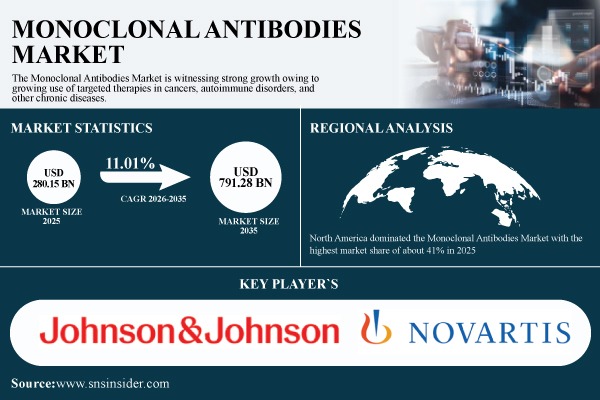
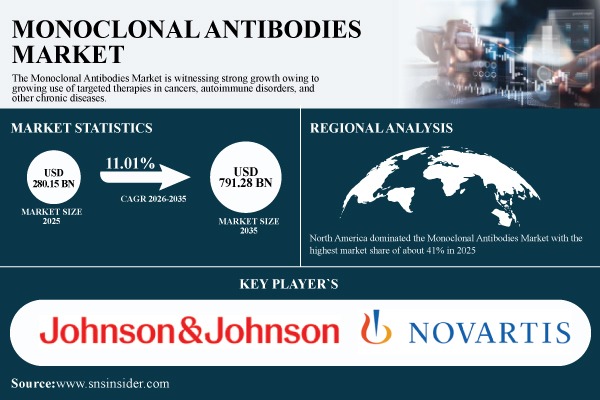
According to SNS Insider, The Monoclonal Antibodies Market was valued at USD 280.15 Billion in 2025 and is expected to reach USD 791.28 Billion by 2035, growing at a CAGR of 11.01% from 2026 to 2035. The demand is increasing due to the increased application of targeted therapies in cancer, autoimmune disorders, and other chronic ailments, as monoclonal antibodies are highly specific in targeting the disease-specific antigens, hence offering effective treatments. Innovations in humanized and human antibodies, ADCs, and bispecific antibodies have continued to increase the development pipeline. According to WHO and IARC, there were 20 million new cancer cases and 9.7 million cancer deaths worldwide in 2022, thus creating huge demand for the targeted therapy of cancer.
Personalized medicines, bispecific antibodies, and ADCs are becoming very significant in increasing the therapeutic indications in oncology and immunology, aided by innovations in antibody engineering, protein design, and ADC technologies.
Download the Monoclonal Antibodies Market Sample Report: https://www.snsinsider.com/sample-request/10953
Monoclonal Antibodies Market Key Highlights
- Market size, 2025: USD 280.15 Billion
- Market forecast, 2035: USD 791.28 Billion
- CAGR: 11.01% from 2026 to 2035
- Largest region: North America, approximately 41% share in 2025
- Fastest-growing region: Asia Pacific, approximately 12.32% CAGR
- Largest antibody type: Human, approximately 59% share in 2025
- Fastest-growing antibody type: Humanized, approximately 12.07% CAGR
- Largest production method: In Vitro, approximately 65% share in 2025
- Fastest-growing production method: In Vitro, approximately 11.20% CAGR
- Largest application: Oncology, approximately 49% share in 2025
- Fastest-growing application: Autoimmune Diseases, approximately 12.58% CAGR
- Largest end use: Hospitals, approximately 60% share in 2025
- Fastest-growing end use: Specialty Centers, approximately 12.29% CAGR
Market Relevance
Monoclonal antibodies have increasingly gained importance within the realm of modern therapies, especially since they provide high specificity in the targeting of antigens involved in diseases ranging from oncology to autoimmune disorders. According to an American study conducted using the country’s electronic health records, more than 15 million people out of a total population of about 329 million suffer from autoimmune disorders.
Monoclonal Antibodies Market Overview
The market is made up of human and humanized antibodies created using in vitro processes and applied in hospitals and specialized centers for cancer and auto-immune diseases. Human antibodies continue to be popular because of their safe nature and low immunogenicity, while the humanized antibodies continue to increase their market share since antibody engineering technology continues to make them less immunogenic but equally effective.
Strategic Market Outlook
There is great potential for further use of antibodies to treat diseases other than oncological diseases such as auto-immune diseases, neuro-degenerative diseases, cardiovascular diseases, infectious diseases, and orphan diseases since there will be identification of new targets. Recently approved monoclonal antibodies for Alzheimer’s disease are a good example of expanded use in treatment of non-oncological diseases.
However, high cost of development and manufacture are the most notable barriers for monoclonal antibodies. Monoclonal antibodies are complicated biological products that require use of advanced biotechnology in terms of cell culture technology, bioreactor, purification, and analysis and hence high cost of manufacturing facilities and personnel.
Monoclonal Antibodies Market Regional Analysis
North America was the dominant region, accounting for about 41% of the worldwide market share in 2025, driven by an advanced healthcare sector, high level of biologics research and development activities, and clinical application of monoclonal antibodies. In North America, the United States dominated the market, accounting for about 91.0% of the regional market revenue, owing to an advanced healthcare sector and pharmaceutical & biotechnology industry presence.
The U.S. Monoclonal Antibodies Market was valued at USD 104.52 Billion in 2025 and is expected to reach USD 295.34 Billion by 2035, growing at a CAGR of 11.01% from 2026 to 2035.
The Europe Monoclonal Antibodies Market occupied 30.0% share of the global market in 2025, which was estimated at USD 84.05 billion and is expected to grow up to USD 228.13 billion by 2035, exhibiting 10.50% CAGR between 2026 and 2035. Growth is driven by advanced healthcare infrastructure, biopharmaceutical research, and developed regulatory structure of the European Medicine Agency. Germany was responsible for around 31.0% of the revenue share in Europe in 2025, thanks to the highly developed pharmaceuticals and biotechnology industries.
The Asia-Pacific region has the highest growth rate, at a CAGR of about 12.32%, during the period from 2026 to 2035, which is fueled by improvements in healthcare infrastructure, increase in prevalence of chronic diseases, and increased biosimilar production in countries such as China, India, Japan, and South Korea. In 2025, the region’s market share was about 18.0% that of China.
Middle East & Africa: The UAE accounted for approximately 18.0% of regional revenue in 2025, supported by improving healthcare infrastructure and rising investment in medical technology.
Latin America: Brazil led regional revenue at approximately 40.0% in 2025, supported by rising demand for oncology and immunology treatment.
Buy the Monoclonal Antibodies Market Report with Competitive Analysis and 2035 Forecast: https://www.snsinsider.com/checkout/10953
Monoclonal Antibodies Market Segment Analysis
By Type: The human antibodies dominated the market with about 59% market share in 2025, owing to their better safety profile and less immunogenicity. The fastest growing sub-segment is the humanized antibodies with CAGR of about 12.07%, due to their ability to reduce immunogenicity.
By Production: Production In Vitro holds a market share of about 65% in 2025 and also represents the most rapidly growing technology, having an annual growth rate of about 11.20%, supported by controlled manufacturing environments, scalability, and consistent quality control.
By Application: In 2025, Oncology was estimated to have a market share of about 49% due to extensive usage of monoclonal antibodies in the treatment of cancer. Autoimmune Diseases is currently the most rapidly growing application with a CAGR of about 12.58%, fueled by high incidences of rheumatoid arthritis, psoriasis, and IBD.
By End Use: Hospitals accounted for around 60% market share in 2025, supported by state-of-the-art treatment facilities and dedicated cancer and immunology clinics. Specialty Centers are the fastest-growing segment, at around 12.29% CAGR, driven by rising demand for targeted biologic therapies and outpatient infusion services.
Monoclonal Antibodies Market Key Trends
- Rising prevalence of cancer, autoimmune, and chronic diseases driving demand for targeted antibody therapy
- Increasing adoption of personalized medicine encouraging antibodies targeted to specific disease biomarkers
- Growing use of bispecific antibodies and antibody-drug conjugates expanding therapeutic applications
- Advancements in antibody engineering and conjugation technologies enhancing specificity and clinical performance
Competitive Landscape
The Monoclonal Antibodies Market includes established pharmaceutical leaders and specialized antibody developers, with competition centred on bispecific antibody platforms and expanding indication pipelines. In 2025, nine of the total number of newly approved drugs were monoclonal antibodies, reflecting the pace of innovation in the category.
In 2026, Genmab A/S advanced its antibody portfolio through continued development of bispecific and next-generation antibody candidates, including programs leveraging its DuoBody and HexaBody platforms. Johnson & Johnson continued expanding its monoclonal antibody portfolio through further development and commercialization of antibody-based therapies including DARZALEX, RYBREVANT, TECVAYLI, and TALVEY, supported by its collaboration with Genmab. AbbVie continued advancing its antibody pipeline, including EPKINLY (epcoritamab), a CD3xCD20 bispecific antibody developed with Genmab for B-cell malignancies. In 2025, Genmab continued expanding its monoclonal and bispecific antibody development pipeline, with multiple proprietary and partnered candidates progressing through clinical development.
Major key players include
- F. Hoffmann-La Roche Ltd.
- Johnson & Johnson
- AbbVie Inc.
- Amgen Inc.
- Merck & Co., Inc.
- Bristol Myers Squibb Company
- Novartis AG
- Pfizer Inc.
- Eli Lilly and Company
- AstraZeneca plc
- GSK plc
- Sanofi S.A.
- Regeneron Pharmaceuticals, Inc.
- Biogen Inc.
- Daiichi Sankyo Company, Limited
- Takeda Pharmaceutical Company Limited
- UCB S.A.
- Genmab A/S
- Gilead Sciences, Inc.
- Astellas Pharma Inc.
Explore the Complete Monoclonal Antibodies Market Report: https://www.snsinsider.com/reports/monoclonal-antibodies-market-10953
